
Halfway Through 2026: Why Nordic Resilience no longer guarantees Execution Readiness
- Insights

- Jul 1
- 7 min read
Updated: Jul 16
The defining executive error of 2026 is mistaking resilience for readiness. The Nordic economies continue to demonstrate many of the strengths that have long defined the region—high trust, digital maturity, institutional stability, and globally competitive industries. Yet resilience alone no longer guarantees execution.

As geopolitical uncertainty, technological disruption, and capability shortages accelerate, the decisive advantage shifts from enduring change to anticipating it.

For executive teams, the challenge is no longer protecting the organization from volatility, but ensuring it can translate strategic intent into organizational action before external pressures become internal constraints.
Key Findings
The Symmetrical Growth Illusion (CFO Focus): Danish GDP expanded by 1.5% in early 2026, but over two-thirds of this growth was concentrated in a single sector—pharmaceuticals situating production abroad—masking persistent domestic stagnation. Executive Implication: CFOs must decouple capital allocation from headline growth metrics and aggressively reallocate resources to address domestic operational stagnation.
The AI Scaling Gap (COO Focus): While 88% of Nordic organizations have initiated AI deployments, only 6% are capturing an enterprise-level EBIT impact of 5% or more due to a lack of deep operational integration. Executive Implication: COOs must transition capital from generic software procurement to end-to-end workflow and operating model reinvention.
The Productivity Deficit (CHRO & CPO Focus): Despite record-high regional employment—exemplified by Denmark's 76.5% employment rate—overall labor productivity continues to decline or stagnate. Executive Implication: CHROs must pivot from volume-based recruitment to strategic capability density, actively reducing organizational drag and increasing output per hour worked.
The Systemic Readiness Gap (Board Focus): A stark misalignment exists between personal employee readiness to adopt emerging technologies (70%) and executive confidence in their organization’s systemic preparedness (only 27%). Executive Implication: Boards must evaluate executive performance not on strategic design, but on the speed and quality of organizational change execution.
Strategic Key Takeaways
Decouple Performance from Macro Trends: Understand that headline regional GDP and employment figures do not reflect the specific operational realities of your industry or enterprise.
Rebalance Technology Capital Allocation: Pivot from procuring AI tools to investing heavily in change management, process redesign, and behavioral upskilling, ensuring that 70% of transformation efforts are focused on the organizational system.
Treat Leadership Stability as an Execution Variable: Establish continuous, data-driven talent mapping and predictive succession pipelines to eliminate the operational paralysis associated with executive transitions.
Accelerate Decision-Making Velocity: Address internal organizational drag by simplifying reporting structures, unifying information flows, and defining clear, uncompromised mandates for all senior leaders.
True strategic readiness is not measured by the stability of your starting position, but by the velocity of your next decision.
Market Observation: The Mirage of Nordic Macro Stability
The prevailing executive consensus across the Nordic region centers on a narrative of structural strength. Nordic economies are widely regarded as highly resilient, underpinned by deep institutional trust, advanced digital infrastructure, and a workforce capable of rapid adaptation. Macroeconomic performance in the first half of 2026 appears to validate this confidence. The Danish economy, for instance, posted a revised GDP growth rate of 1.5% in the first quarter of 2026 compared to the final quarter of 2025, significantly outperforming the broader Eurozone. Public finances remain fundamentally sound, with persistent balance of payments surpluses and low debt ratios providing a robust safety net against geopolitical volatility.

This macroeconomic divergence exposes a critical leadership challenge. Nordic corporate leaders have long relied on the region's stable social and economic frameworks to absorb external shocks. Yet, stability does not automatically translate into strategic velocity. While Nordic organizations have proven highly capable of withstanding disruption, they are increasingly slow to make the decisive shifts in capital allocation, operational structures, and leadership capability required to capture new growth frontiers.
The strategic risk is that resilience becomes an excuse for execution delay, allowing external competitive pressures to harden into permanent internal operational constraints.
The Productivity Paradox: Capital Allocation and The Capability Advantage
The decoupling of export-led manufacturing and the domestic service economy has triggered a critical productivity challenge across the Nordics. For several quarters, regional employment has hovered at record highs, yet hours worked and overall labor productivity have stagnated or declined.
In Denmark, while employment rose by 0.2% in early 2026, labor productivity fell once again. This pattern indicates that organizations are expanding their headcount to cope with operational complexity rather than increasing the value-added output per employee.
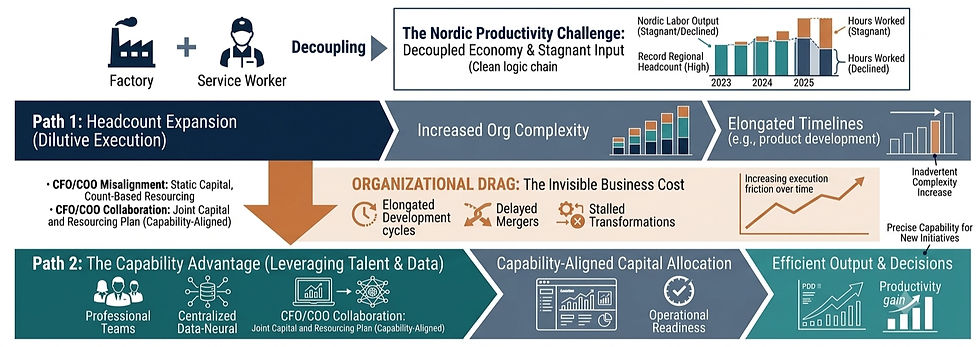
Through the lens of The Capability Advantage, this operational drag is compounded by the intense competition for specialized talent. In highly integrated and unionized Nordic labor markets, the cost of labor remains high and inflexible, creating an elevated cost base that compresses operating margins when growth slows. When organizations attempt to resolve capacity constraints by simply hiring more personnel, they inadvertently increase organizational complexity and dilute decision-making velocity.
The AI Scaling Trap: Activating the Nordic Readiness Flywheel
A prime example of the gap between technical adoption and operational readiness is the implementation of artificial intelligence across the Nordic region. On paper, the Nordics are digital frontrunners. Research shows that approximately 88% of organizations have deployed AI in at least one business function.
However, the reality of value capture tells a fundamentally different story. Less than 10% of enterprises have successfully scaled AI across multiple business units, and a mere 6% report a meaningful enterprise-level EBIT impact of 5% or more.

The primary obstacle to capturing value is rarely technical; it is institutional unpreparedness. While 70% of employees express personal confidence in utilizing AI, only 27% of business leaders believe their organizations possess the systemic readiness required to manage a hybrid workforce of humans and AI agents7.
The Diluted Mandate: Enterprise Risk and Predictive Succession
The ultimate bottleneck to strategic speed is the quality and stability of leadership mandates. In highly competitive Nordic talent markets, maintaining leadership continuity and succession readiness has transitioned from a routine human resources function to a core element of corporate risk management. When critical executive roles remain vacant or are filled by leaders with ill-defined mandates, the cost to the business is immediate and compounding.

Many Nordic executive teams are currently operating under diluted mandates, where leaders are consumed by short-term operational firefighting—such as navigating supply chain disruptions or localized inflation—at the expense of long-term strategic execution. This dilution of focus creates a cascade of delayed decisions, resulting in missed market opportunities, misaligned capital expenditure, and a weakened leadership pipeline.
Succession planning in many organizations remains reactive rather than predictive. When a key executive departs, the organization is often forced to initiate a prolonged external search, leading to months of operational paralysis in critical business units.
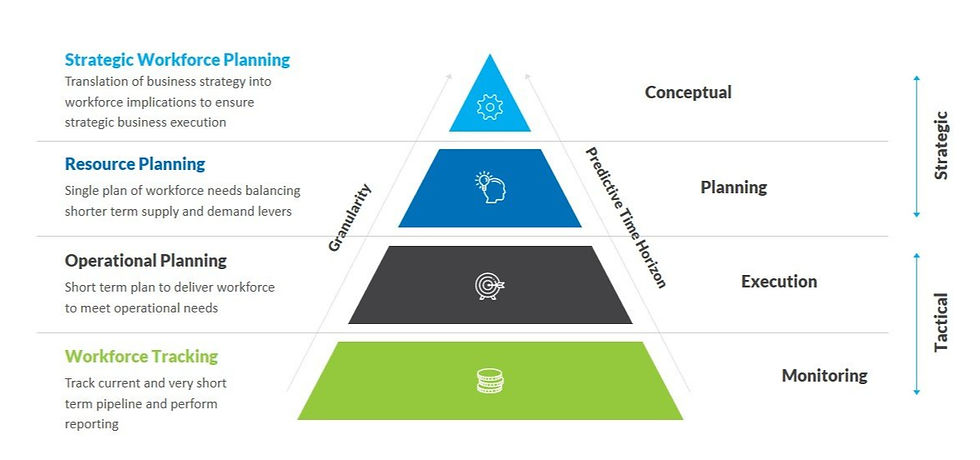
Organizations that master execution, by contrast, treat leadership stability and capability building as continuous strategic variables. By utilizing advanced talent intelligence and predictive retention analytics, these forward-looking boards identify succession risks early, ensuring that leadership mandates are continuously aligned with the future operating model of the business.
In the Nordic leadership landscape—where trust, long-term commitment, and cultural alignment play a central role—retention is not merely an HR metric; it is an enterprise risk and execution variable.
The Strategic Reframe
The critical challenge for Nordic enterprises in the second half of 2026 is not a lack of market opportunity or technological access, but an execution deficit rooted in organizational inertia.
The strategic dialogue must shift from celebrating structural resilience to actively evaluating operational readiness. Resilience is a passive, defensive quality; it measures an organization's capacity to absorb external shocks without breaking. Readiness, by contrast, is an offensive, active capability; it measures an organization's speed in reallocating capital, deploying new technologies, and mobilizing leadership talent to capture value ahead of the competition.
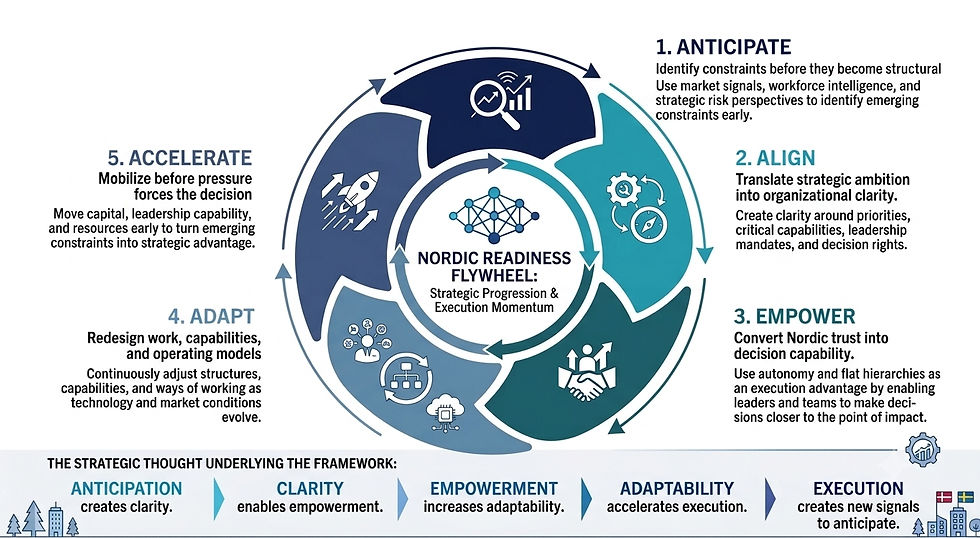
The core issue is that the very structures that preserve stability in the Nordic model—such as decentralized decision-making and consensus-driven cultures—can become significant barriers to execution speed when rapid, difficult strategic decisions are required.
The central strategic reframe is therefore threefold:
Resilience absorbs disruption. Readiness determines who acts first. Passive shock absorption must yield active, pre-emptive market positioning.
Trust creates alignment. Readiness converts alignment into execution. Consensus-driven alignment must be translated into disciplined operational momentum.
From strategic ambition to execution capability: Aligning executive mandates, succession pipelines, and transformational capital to guarantee delivery.
In the second half of 2026, the most expensive strategic plan is the one that assumes organizational capability will catch up to corporate ambition on its own.
Implications for Executives
To bridge the gap between macro resilience and execution readiness, boards and executive teams must critically evaluate their current operating assumptions:
CEO & Board Focus: Are we confusing macro-level economic resilience with micro-level operating speed? Leaders must assess whether the organization’s current profitability is driven by genuine productivity gains or merely by favorable external market factors, such as sector-specific export booms.
CFO Focus: Is our capital allocation targeting simple automation, or are we financing fundamental operating model reinvention? Executive teams should review whether technology capital is being used to fundamentally redesign how work gets done, or if it is simply adding expensive digital tools on top of outdated, inefficient processes.
COO Focus: Where are high performers masking structural operational drag, and where are consensus loops diluting strategic momentum? COOs must identify which strategic initiatives are delayed due to capability gaps in key roles or diluted executive mandates, taking immediate action to align talent architecture with future strategic requirements.
CHRO & CPO Focus: Are we running a reactive recruiting function, or are we actively building predictive leadership pipelines aligned with our future capability needs? CHROs and CPOs must evaluate if their succession planning relies on subjective assessments or if it is powered by rigorous analytics that anticipate talent mobility and capability needs before they turn into operational constraints.
Closing Perspective
Where leadership capability, strategic execution, and organizational risk intersect, the quality and timing of executive decisions determine market performance. Aligning talent architecture and leadership readiness with future strategic priorities remains the most decisive action a board can take to secure long-term value creation. Friis+Børgesen works at this critical intersection, partnering with Nordic boards and executive teams to strengthen decision clarity, mitigate leadership risks, and build execution readiness for the challenges of 2026 and beyond.
To discuss what this strategic shift means for your organization, we invite you to connect with our advisory team to exchange perspectives.


Comments