
Why CFOs are becoming the architects of industrial transformation
- Insights

- Mar 5
- 6 min read
Updated: Jul 9
As industrial organizations across the Nordic region accelerate investments in automation, digital infrastructure, and generative artificial intelligence, the mandate of the Chief Financial Officer is undergoing a profound structural shift. Modern industrial transformation is no longer a purely technological or financial challenge; it is fundamentally an execution and capability challenge.

By mastering dynamic capital allocation and bridging the gap between balance sheet discipline and strategic workforce planning, Danish and Nordic CFOs are stepping into a broader enterprise leadership role—redefining how organizations translate technological vision into sustainable economic value.
Key Findings
Geopolitical and operational volatility has elevated organizational resilience to a board-level strategic priority, with 88 % of Danish CFOs placing significant emphasis on safeguarding operational continuity.
The primary barrier to successful industrial modernization is organizational and talent bandwidth rather than capital scarcity, with 54 % of finance leaders citing limited execution capacity as their greatest challenge.
Proactive, strategy-influencing CFOs derive far higher returns on digital investments, being more than twice as likely to capture measurable value from artificial intelligence than strategy-supporting peers.
Strategic Workforce Planning (SWP) correlates directly with superior enterprise performance, enabling top-tier organizations to generate up to 300 % more revenue per employee by treating talent with the same rigor as financial capital.
Strategic Key Takeaways
Adopt an integrated capital allocation framework that treats human capabilities and technological assets as codependent, ensuring projects are never funded beyond the organization's capacity to execute.
Transition from static annual budgets to agile, multi-scenario planning to dynamically navigate shifting trade policies, logistical disruptions, and rapid technology life cycles.
Invest in a unified, connected data infrastructure to break down administrative silos and provide a single, reliable fact base for both financial and talent decisions.
Mitigate executive and technical talent shortages by leveraging advanced retention and succession analytics to protect critical leadership pipelines in highly competitive Nordic talent markets.
Bridging vision and value: The Nordic industrial landscape in transition
The industrial landscape across Denmark and the wider Nordic region is experiencing a structural realignment driven by macroeconomic headwinds, geopolitical friction, and rapid technological acceleration. Nordic companies operate in an environment characterized by persistent global trade volatility, supply chain disruptions, and changing economic conditions. In Denmark, companies on the OMXC25 index are navigating a landscape where geopolitical risk has surged to a top-tier concern, with 70% of Danish CFOs identifying it as a primary threat to performance.

To safeguard competitiveness under these conditions, industrial organizations are accelerating investments in digital infrastructure, automation, and generative artificial intelligence. Consequently, the CFO has transitioned from a traditional transaction-oriented function to a core strategic partner to the CEO—a transformation reflected in high market mobility, where approximately 50% of the CFOs among the largest Nasdaq Stockholm-listed companies have been replaced in the last three years.
In corporate giants across Scandinavia, such as Maersk and the LEGO Group, the finance function is deliberately structured to serve as an agile business partner, driving both organizational resilience and digital growth. To succeed, today's finance leaders must lift their heads from the spreadsheets and act as strategic sparring partners.
Bridging the execution deficit: Why talent constraints dictate the boundaries of capital deployment
Industrial modernization is fundamentally a human capital challenge rather than a pure technology procurement effort. Historically, corporate capital allocation has treated technology acquisitions and workforce planning as separate, parallel workstreams. Today, this disconnect represents a primary point of failure for large-scale transformations. In Denmark, industrial modernization projects frequently stall because of an acute shortage of specialized skills, with more than half of Danish CFOs identifying the digital skills gap as the most challenging obstacle in their transformation journeys. Furthermore, 54% of Danish finance leaders cite limited organizational bandwidth as the primary barrier to translating strategic goals into operational realities.
The digital skills gap is not a novel structural challenge, but rather a persistent execution bottleneck. Historical benchmarks reveal that as early as 2019, nearly half of Danish CFOs cited a lack of employee IT skills as a major hurdle to digital transformation, while more than a third noted that low general technical knowledge at the executive level slowed organizational transition.

Yet, modern performance dynamics show that companies resolving these talent bottlenecks capture disproportionate returns. S&P 500 organizations that excel at maximizing their return on talent generate an astounding 300 percent more revenue per employee compared to the median firm. Additionally, integrating structured, AI-enabled workforce planning yields an average of 10% savings in labor costs by eliminating structural overstaffing, minimizing involuntary attrition, and optimizing resource reallocation.
A compelling illustration of this analysis of capital allocation constraints is observed in a large Asian manufacturer. Despite possessing the financial reserves to fund a third plant expansion, the organization limited its capital deployment to two facilities after a rigorous capacity assessment of its technical labor pipeline.
By pacing physical expansion to match its realistic talent recruitment and upskilling pipeline, the company avoided costly underutilization and protected its long-term financial health.
The proactive premium: How strategy-influencing finance leaders unlock digital returns
To maximize the return on industrial investments, CFOs must move beyond passive stewardship and assume a proactive, strategy-influencing role within the executive committee. Passive financial oversight—characterized by static hurdle rates and cost-containment mandates—frequently destroys value during complex digital transformations. In contrast, finance leaders who actively co-design and guide the transformation agenda achieve structurally superior outcomes.
Strategy-influencing CFOs outperform their strategy-supporting peers across every critical technology deployment metric, from cloud-based cost optimization to the practical integration of artificial intelligence, as outlined in the comparative data below:
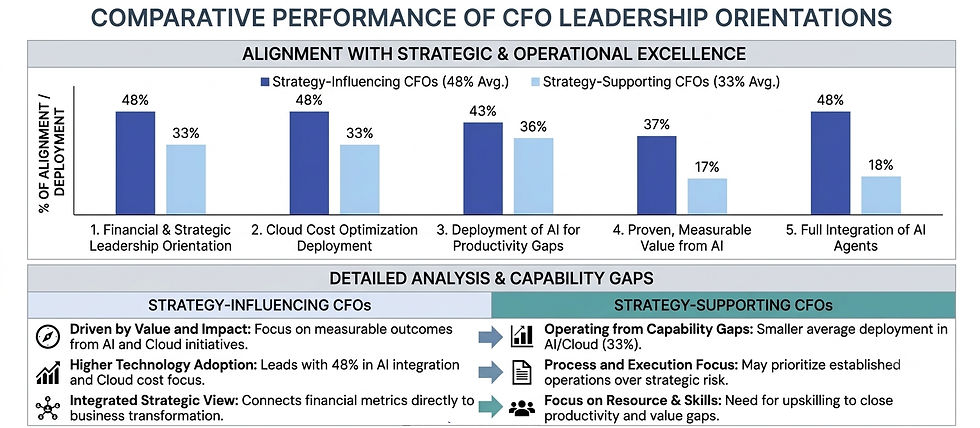
This performance delta stems from how these leaders configure their decision-making frameworks. Rather than evaluating technology as an isolated operational expense, strategy-influencing CFOs integrate technological maturity directly into corporate performance management. This integration enables organizations to leverage advanced predictive data, allowing them to adapt to market volatility and allocate resources with high precision.
A prime example is VELUX, where the finance function acts as a digital front-runner by utilizing integrated technology to uncover cost efficiencies and drive growth. Similarly, Chr. Hansen demonstrated that integrating strategic capital allocation with sustainability objectives can transform corporate performance, generating 82% of its revenue from products that directly support the United Nations Sustainable Development Goals.
Navigating the skills arbitrage: Reallocating human capital in automated ecosystems
The rapid adoption of industrial automation and generative artificial intelligence presents a structural challenge for Nordic executives. McKinsey estimates that up to 30% of current work hours could be automated by 2030, triggering a profound shift in occupational demand and skill requirements across the industrial value chain.
This shift introduces an automation paradox: while technological platforms automate high-volume, repetitive tasks, they simultaneously increase the strategic importance of highly specialized human expertise.
In an automated environment, the cost of human error, system downtime, and strategic misalignment escalates exponentially.
Consequently, the primary responsibility of the CFO shifts from managing headcount reductions to dynamically reallocating capital toward talent upskilling and capability building.
This structural shift requires CFOs to move away from static annual budgets toward dynamic, scenario-based workforce planning. A North American software enterprise demonstrated the efficacy of this approach by forecasting labor supply and demand across its product, technology, and operations teams based on anticipated AI use cases.
By identifying low-priority projects to stop or freeze, the company successfully reallocated specialized engineers to high-priority product launches, adjusting its staffing dynamically across multiple adoption scenarios.
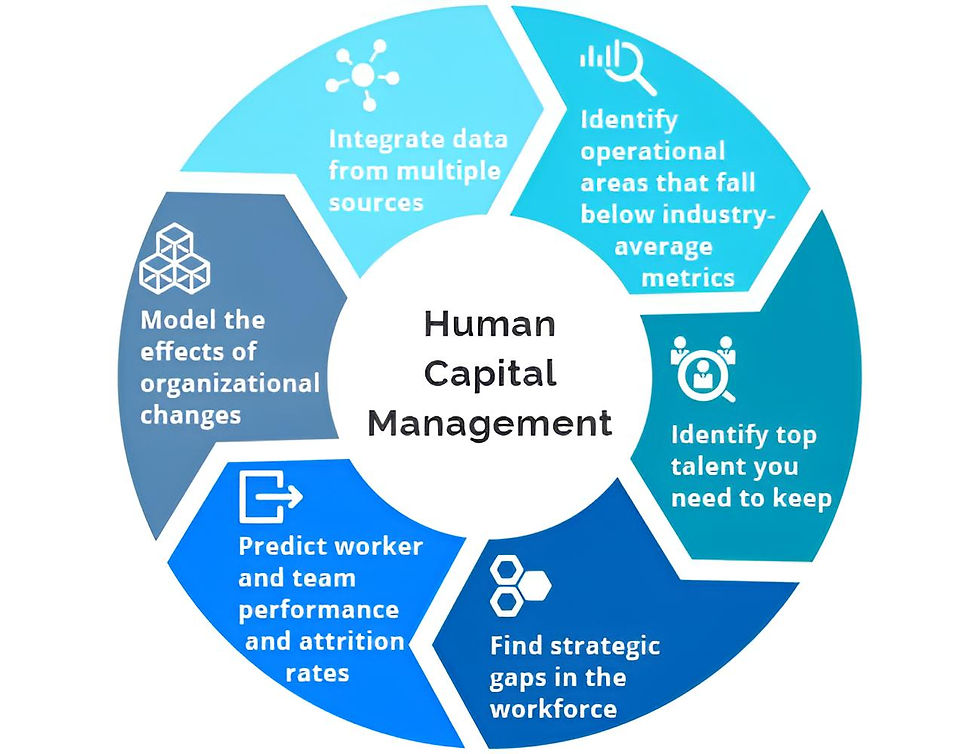
Furthermore, advanced AI-driven analytics can process vast datasets to identify patterns and leading indicators of employee attrition or emerging skill shortages, enabling finance and HR leaders to act proactively rather than reactively.
Implications for executive leadership: Shaping the resilient organization
For corporate boards, chief executive officers, and chief financial officers across Denmark and the wider Nordic region, navigating this landscape requires translating boardroom intent into operational mechanisms.
1. Organizations must establish a continuous, multi-scenario capability framework. By modeling future talent shifts alongside capital investments, companies can predict and close skill gaps before they disrupt operations. CFOs must collaborate with HR leadership to align internal talent taxonomies, using advanced data tools to map existing organizational capabilities against future technological requirements.
2. Resilience must be embedded directly into corporate risk management. In response to severe geopolitical and trade volatility, 47% of Danish CFOs are integrating resilience into enterprise risk processes, while 38% prioritize cross-functional governance and 37% focus on strengthening internal capabilities. Financial allocations must support targeted investments in advanced technologies to enhance reporting and scenario planning, providing the data-driven foresight necessary for agile decision-making.
3. Leadership retention must be treated as a strategic priority. The Nordic executive market is characterized by severe talent constraints, low candidate mobility, and high CFO turnover. Organizations must deploy structured retention analytics, focusing on the four critical pillars of workforce planning, employee experience, succession planning, and advanced talent sourcing. Protecting these leadership pipelines is essential for maintaining the organizational stability required to deliver long-term value in a rapidly changing world.


Comments